Q Report: Opening Hormuz (A Swashbuckling Adventure)

All,
Somewhere in 2036, I was deep into a highly specific experimental performance art attempt involving twelve cracked cathedral mirrors, a rusted/haunted calliope, six gallons of Vantablack paint, and an albino peacock named Jerome who had thus far demonstrated no clear understanding of symbolism, performance, or basic professional courtesy. The piece was called “Empire as a Self-Devouring Carousel” and, like most worthwhile art, it had already injured two student workers, deeply traumatized a surprise OSHA inspector, and caused a visiting professor to loudly suggest that civilization was an entirely failed attempt. I was just reaching the crucial crescendo, wherein I planned to lower myself by sturdy chain into a repurposed baptismal font full of hot fudge while reciting the parts list of a Tomahawk missile, when the Timephone began to ring.
There are few sounds in this cooling cosmos more hateful than the ring of the Timephone. It's not a sound, really. It's the pulse of history being felt backwards in our bones. It's the cry of causality filing a complaint. It's the mournful howl of fate declaring that once again mankind has found a way to weaponize stupidity. The entire gallery froze. Jerome spread his tiny wings. The mirrors trembled. One of the workers crossed himself, though I had previously explained that the Timephone obeyed no gods recognized by accredited religions. I hit the answer key with the solemn dread of a man accepting another collect call from the apocalypse.
“Q Speaking” I said
“Q,” came the voice, bloated with temporal authority and the confident slur of inherited power. “This is Time Tyrant Trump. We need you to open the Strait. Swashbuckler Guild Priority One.”
I wasn’t surprised. No. By that point the whole rotten century had become an escalating pageant of insecure men demanding impossibly moronic solutions to institutional problems of greed, incompetence, and corruption. Trade had seized up, the maps were glowing red, the pundits were frothing on every stream, and somewhere a room full of farting project managers had clearly concluded that the only force capable of restoring the sacred flow of oil, money, and monetized content was a privately assembled pirate… ahem… "Privateer" armada commanded by the only certified Over Admiral in the free and brave new worlds. I looked down at the cooling fudge, at Jerome, at the trembling students, and knew at once (and once again) that my art would have to wait. Once again history had interrupted an artist at work to request something stupid, vulgar, and expensive.
The authorizations came through in waves. Budget authority: five hundred billion dollars. Mandate: immediate. Objective: open the Strait of Hormuz by force, terror, theater, or superior maritime tactics. Rules of engagement: classified, contradictory, and written in the sort of legal finality that suggests entire law schools have been quietly guillotined. I was granted privateering authority so broad it effectively transformed me into a roving maritime king. If my feet were wet I was universally legally immune. Every scrap yard, luxury marina, naval boneyard, and floating casino on Earth became my buffet.
We bought decommissioned cruise ships and turned them into missile barges of leisure. We outfitted sunburned vacation vessels with Stinger systems, clever cocktails, and patriotic outerwear, all while explaining the basics of drone recognition. We seized aircraft carriers on their way to the grave and refitted them with colossal inflatable kite sails, decommissioned nuclear reactors be damned. The age of stealth and satellites had plainly failed to account for the strategic majesty of a warship moved by whimsy. We accepted the “voluntary” donation of several luxury superyachts from billionaires whose objections were overcome by the simple presentation of a Priority One seal and an armed chorus of Secret Agents singing sea shanties in four-part harmony.
It was a beautiful thing to behold, in the way plague fires are beautiful from a distance. The whole demented liberation fleet came together as though the human race had, after millennia of error, finally committed itself fully to the proposition that if anything, war should also be extremely fun. Secret agents arrived from every chapter house of the Swashbucklers Guild: sword-wielding maniacs who had trained all their lives in the delicate arts of espionage, fencing, sabotage, dramatic arts, haberdashery, and maintaining a confident smile during total catastrophe. Some came draped in velvet, some in tactical leather, some in naval coats so ornate they looked designed by cocaine itself. All of them believed, with the pious certainty normally reserved for saints and lunatics, that they had been born for this one impossible mission.
We assembled off the shores of Muscat under a bright full moon. There was to be a final readiness briefing, a solemn pep talk, voluntary prayer, and then a clean deployment at dawn. Instead, that night, there occurred a party of such world-ending intensity that the fleet nearly destroyed itself before ever reaching dawn. The drugs came out from teak shelving in glittering continental quantities. The liquor flowed with antediluvian determination. Nitrous tanks rolled the decks like depth charges of joy. Duels broke out over rank, scarves, lovers, trivia, and one particularly vicious dispute regarding whether a curved saber was more spiritually honest than a rapier. By sunrise nearly half the force was gone. Murdered, poisoned, unconscious, disappeared into the sea, or having swum for shore to begin new and quieter lives in Muscat. Thousands took one look at the schedule of planned action and sensibly concluded that a sunlit Omani courtyard and a modest life of grilled fish held greater appeal than being exploded for petroleum.
No matter. I had always planned for this. What would be the point of the Timephone, if not? I stood before the surviving fleet as dawn rose over May 1, 2026. I wore a coat stitched from historic pirate flags and declared that history does not require courage, only momentum. The remaining agents cheered. Horns blared. Fireworks launched prematurely from at least three vessels. We set our course for the Strait. By evening we had arrived, or rather blundered magnificently into the jaws of a resistance so overwhelming that any ordinary commander would have died of panic before the first impact.
Weaponized drones rose in black swarms until they blotted out the sun itself, a mechanical locust cloud humming with lethal vector. Missiles struck vessels and burst into nerve gas clouds that rolled over the crashing waves in slick green veils. Dirty bombs air-burst overhead with a ghastly darkness, soaking the battlefield with a black, hot, tar-like rain that came down in poisoned curtains and clung to everything it touched. Superstructures burned. Kite sails ignited like paper tigers. One cruise ship carrying four hundred Stinger-armed honeymooners vanished in a flash so bright it temporarily blinded the adjacent destroyer.
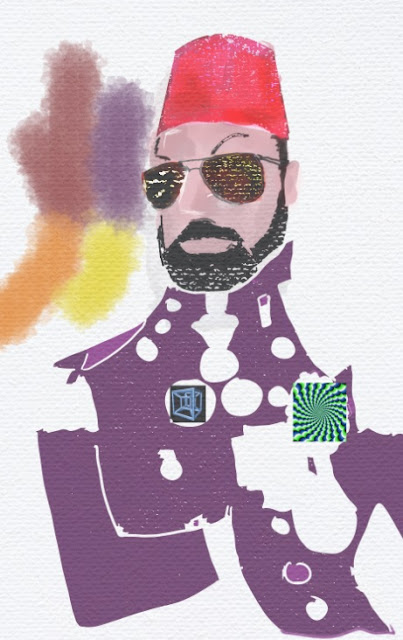
I smiled from the deck of the USS Esmerelda, the weaponized superyacht I had taken from Jeff Bezos and renamed, and the smile was genuine, deep, almost tender. Because I was not on the deck of the USS Esmerelda. Except virtually. No one was on any ship. Those of us still paying attention were doing so remotely, from the other side of the planet. No one was being burned. No one was drowning in burning fuel. No one was breathing gas or swallowing hot radioactive rain. We were all masturbating and eating chips.
Weeks earlier, while the lesser minds of Washington had been drawing arrows on maps and practicing grave facial expressions for the cameras, I had quietly spent a considerable portion of my budget on robots. Hundreds of them. Sailors, officers, deckhands, missile crews, marine boarding units, partying decoys, and one entirely unnecessary but beautiful crew of animatronic swashbucklers capable of drinking, fencing, singing, and dying with astonishing realism. The Disney people wanted any survivors, but there would be none. The entire fleet had been a ghost navy from the beginning, an elaborate mechanical hallucination hurled into the Strait to tempt the enemy into emptying every gun, drone, missile, and forbidden horror in the arsenal.
They took the bait like starving carp. All afternoon and deep into the night Iran expended its wrath against steel hulls crewed by remote. The sky turned black, then green, then the sickly orange of industrial hell. Ships worth millions sank with robots worth billions, and I saluted every one of them as a fellow artist salutes another artist’s willingness to commit completely to the bit. When the smoke cleared, the enemy had exhausted itself in a frenzy of spectacular theoretical war crimes. The actual U.S. losses amounted to one stubborn cat aboard the USS Nimitz who had refused all evacuation orders and elected to ride the old ship into legend. I had him recommended posthumously for the highest available pet distinction.
Iran, clip emptied, accepted all terms of total surrender with a speed that can only come from spiritual exhaustion. The settlement was fair, measured, and entirely in line with the refined merciful traditions of the time. They agreed never again to use the word “nuclear” in speech, text, ceremony, or theory. They agreed that their children would never have access to gender-affirming care. They agreed to cease printing history between the years 1950 and 2027 inclusive, thereby sparing future generations the burden of understanding how any of this dumb shit had happened. They agreed to a trillion dollars in immediate war reparations payable directly to Trump’s memecoin, plus all oil profits in perpetuity, plus several tastefully symbolic concessions involving flags, recognition, and a formal apology to Israel for building elementary schools on their missile targets. Nothing unreasonable. Not after what they had chosen to waste. My precious time.
It took longer than it should have. That is the way of empires. They will spend mountains of money and oceans of blood before parting with a ribbon and a title. But at last Time Tyrant Trump himself placed the Medal of Honor around my neck and commissioned me Space Admiral For Life, which I accepted with the grave humility appropriate to a man who had solved the ancient problem of maritime war by sending machines to suffer in our place. The cameras flashed. The markets steadied. Gas fell below $3.50 a gallon, and across the republic millions of dazed motorists looked up from the pump and felt, perhaps for the first time in years, that humanity might yet be worth the inconvenience.
It’s sad, in a way, that it took so many blown-up children, so many bombed schools, so many generations of men with flags, sermons, and guns to arrive at this final elegant truth. That if humanity insists on organizing itself around oil, fear, and violence, then eventually the only moral answer is to let the robots do the dying while the rest of us stand back, collect our checks, and pretend the lesson was learned.
Still, dawn came. The Strait was opened. The fleet was sunk. The cat was mourned. The gasoline was slightly cheaper. Somewhere in our ruined century, the artist returned at last to their interrupted work. Vantablack everywhere, peacock on the wings, mirrors cracked just so, having once again given civilization just what it needed, and slightly more than it deserved.
Q

Comments